
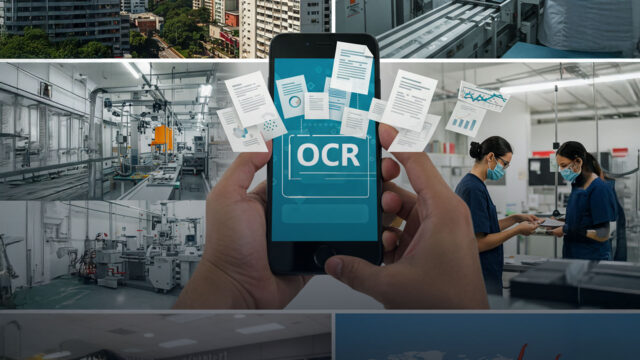
Beyond Traditional OCR: Transforming Paper Workflows into Enterprise Intelligence
It is surprising how many enterprise organizations remain heavily dependent on paper-based processes. Across finance, healthcare, retail, and manufacturing, physical documents—such as vendor invoices, expense receipts, handwritten medical forms, and delivery slips—continue to clog operational workflows and stall decision-making.
Manual data entry drains staff productivity, introduces human error, and creates severe processing bottlenecks. Furthermore, misplaced or misfiled physical documents lead to compliance failures, missed vendor payments, and costly delays.
By implementing SageFoundry AI OCR WGS, enterprise organizations move beyond basic optical character recognition to extract, contextualize, and feed document data directly into core ERP and CRM databases.
Manual Paper Documents ➔ SageFoundry AI OCR Processing ➔ WGS Enterprise ERP Integration
Understanding AI OCR: What Makes It Different?
Unlike traditional OCR systems that merely convert printed images into text, AI-powered OCR leverages machine learning (ML) and natural language processing (NLP) to interpret document context and structure:
[ Traditional OCR: Rigid Scanning ] ➔ [ AI OCR: Contextual Data Extraction ] ➔ [ Enterprise Automated Ingestion ]
Limitations of Traditional OCR
-
Layout Fragility: Breaks down when processing variable document formats or non-standard templates.
-
No Contextual Intelligence: Treats all scanned words and numbers equally without recognizing document semantics.
-
Poor Handwriting Handling: Fails when attempting to interpret handwritten notes or degraded scans.
Advantages of SageFoundry AI OCR
-
Contextual Understanding: Automatically distinguishes vendor names, tax totals, line-item descriptions, and invoice dates.
-
Adaptive Machine Learning: Improves extraction accuracy over time by learning from new document variations.
-
Multi-Format Processing: Ingests structured, semi-structured, and handwritten documents seamlessly.
Capability Comparison: Traditional OCR vs. SageFoundry AI OCR
| Operational Dimension | Traditional Legacy OCR | SageFoundry AI OCR WGS |
| Data Extraction Accuracy | High error rate on variable document templates | Up to 98% accuracy on variable layouts |
| Handwriting Recognition | Unreliable or non-functional | Advanced ML extraction for handwritten text |
| ERP Data Integration | Requires manual verification & re-keying | Direct bi-directional integration with SAP, Oracle, & custom ERPs |
| Processing Speed | Slow, template-dependent scanning | Instant contextual data extraction |
Enterprise Applications Across Key Industries
The combination of SageFoundry AI OCR WGS delivers measurable operational impact across multiple sectors:
-
Finance & Banking: Automates expense management, loan application processing, and Know Your Customer (KYC) document verification, reducing manual data entry time by up to 80%.
-
Manufacturing & Supply Chain: Extracts line items automatically from supplier invoices, purchase orders, and packing slips, accelerating accounts payable reconciliation.
-
Healthcare Institutions: Digitizes doctors’ handwritten clinical notes and patient registration forms, converting them into searchable, compliant electronic health records (EHR).
-
Logistics & Transportation: Processes bills of lading, customs paperwork, and delivery confirmations instantly to prevent shipment disputes and speed up billing cycles.
Strategic System Integration with Walden Global Services (WGS)
Deploying document intelligence models into complex enterprise architectures requires specialized systems integration and regulatory alignment.
SageFoundry AI OCR Engine ➔ WGS Middleware Integration ➔ Core ERP / Database Ingestion
The WGS Integration Advantage: As a premier technology integration partner in Indonesia, Walden Global Services (WGS) connects SageFoundry AI OCR WGS directly to your backend IT infrastructure. WGS configures custom extraction pipelines, ensures data privacy compliance under Indonesia’s UU PDP law, and integrates extracted data streams directly into existing SAP, Oracle, or custom enterprise platforms.
By partnering with WGS, enterprises eliminate paper bottlenecks and transform static physical documents into secure, real-time business intelligence.