
As digital transformation accelerates across Indonesia and Southeast Asia, enterprises are rapidly adopting cloud infrastructure and Artificial Intelligence (AI) to drive innovation. However, this rapid technological expansion brings a significant challenge: unpredictable and spiraling IT costs. Enter FinOps Southeast Asia (Financial Operations) – the cultural practice and operational framework designed to bring financial accountability to the variable spend model of modern technology.
In this comprehensive guide, we will explore what FinOps is, why it has evolved beyond just cloud cost management to encompass AI and hybrid infrastructure, and how enterprises in Southeast Asia can leverage it to maximize the business value of their technology investments.
What is FinOps? Beyond Cloud Cost Management
FinOps is an operational framework and cultural practice that maximizes the business value of technology, enables timely data-driven decision-making, and creates financial accountability through collaboration between engineering, finance, and business teams.
Originally a portmanteau of “Finance” and “DevOps,” FinOps was initially synonymous with Cloud Financial Management. However, as the State of FinOps 2026 report highlights, the discipline has definitively expanded . Today, FinOps encompasses managing spend across all technology categories, including:
- Public Cloud: AWS, Google Cloud, Microsoft Azure
- Private Cloud & Data Centers: VMware, Kubernetes, on-premise infrastructure
- SaaS & Licensing: Databricks, MongoDB, enterprise software
- Artificial Intelligence (AI): LLM API calls (OpenAI, Anthropic), GPU compute, and agentic workflows
The goal of FinOps is not simply to “save money.” Rather, it is about making conscious trade-offs between speed, cost, and quality to get the most value out of technology and drive efficient growth.
The State of FinOps in 2026: Key Market Trends
The global Cloud FinOps market is experiencing explosive growth. Valued at $14.88 billion in 2025, it is projected to reach $26.91 billion by 2030, growing at a Compound Annual Growth Rate (CAGR) of 12.6% . This growth is driven by the sheer scale of wasted IT spend.
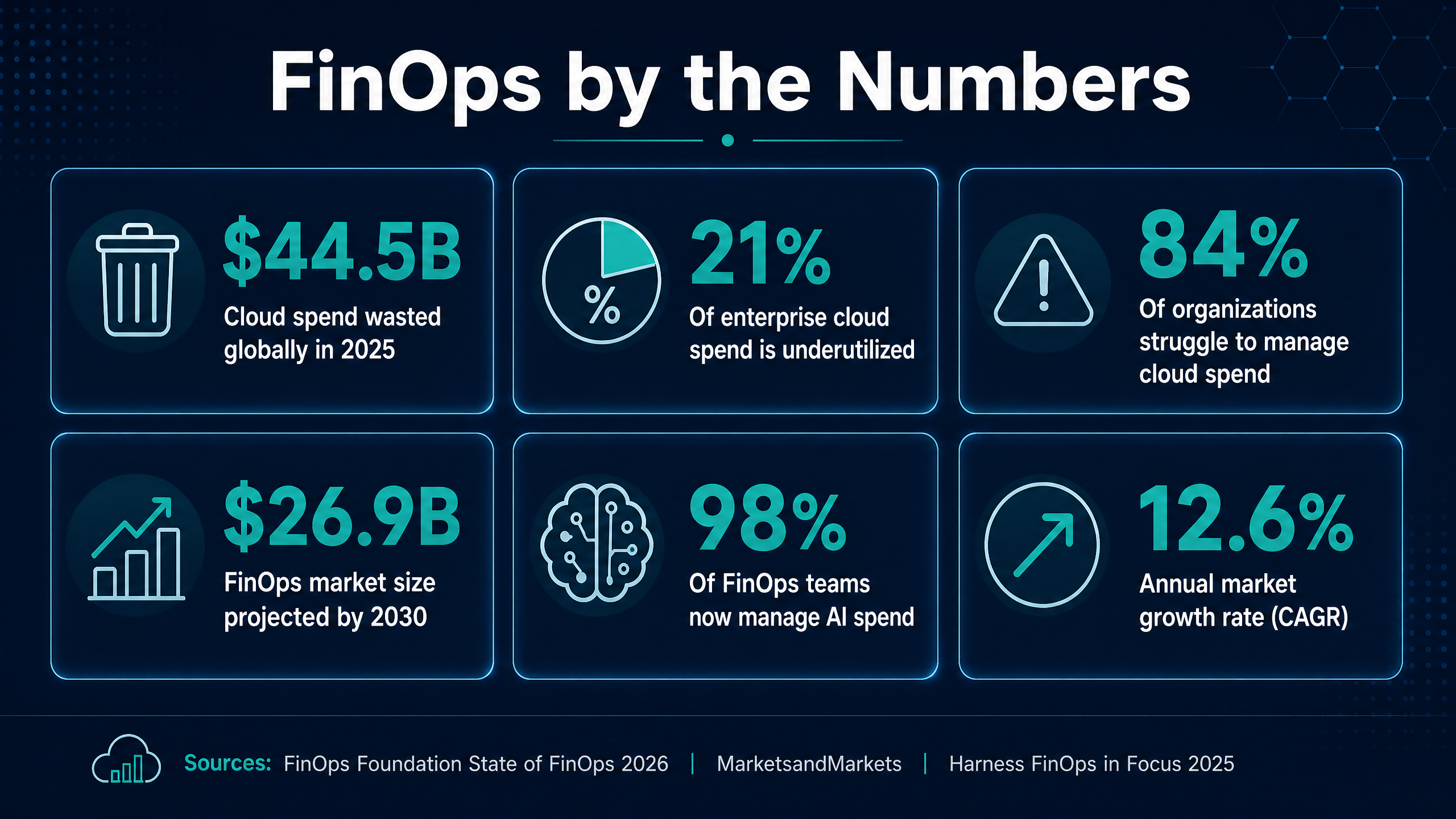
A 2025 report revealed that an estimated 21% of enterprise cloud infrastructure spend is wasted on underutilized resources. Globally, this equates to a staggering $44.5 billion in cloud waste in 2025 alone . Furthermore, 84% of organizations admit they struggle to manage their cloud spend effectively.
The AI Cost Challenge
The most significant shift in 2026 is the integration of AI into the FinOps purview. An overwhelming 98% of FinOps teams now manage AI spend, up from just 31% two years prior.
Managing AI costs introduces unique challenges:
- Complex Pricing Models: Variable costs based on tokens, GPU-hours, inference versus training, and varying rates across providers.
- Allocation Difficulties: Attributing the costs of shared AI models and exploratory pilots to specific business units.
- ROI Uncertainty: Measuring the tangible business value of experimental AI initiatives.
FinOps teams are now tasked not only with governing AI spend but also with finding efficiency gains in traditional cloud infrastructure to self-fund new AI investments.
The FinOps Framework: Core Principles
To successfully implement FinOps, organizations must adhere to the core principles established by the FinOps Foundation :
- Teams need to collaborate: Finance, technology, and product teams must work together continuously.
- Business value drives technology decisions: Decisions should be based on unit economics (e.g., Cost-to-Serve) rather than just aggregate spend.
- Everyone takes ownership for their technology usage: Accountability is pushed to the edge; engineers must consider cost as a first-class metric.
- FinOps data should be accessible, timely, and accurate: Fast feedback loops and real-time visibility drive efficient behavior.
- FinOps should be enabled centrally: A centralized team evangelizes best practices, while execution is federated across engineering teams.
- Take advantage of the variable cost model: Embrace agile, iterative planning and just-in-time purchasing to reduce waste.
The FinOps Lifecycle: Inform, Optimize, Operate
The FinOps practice is an iterative, continuous lifecycle consisting of three primary phases:
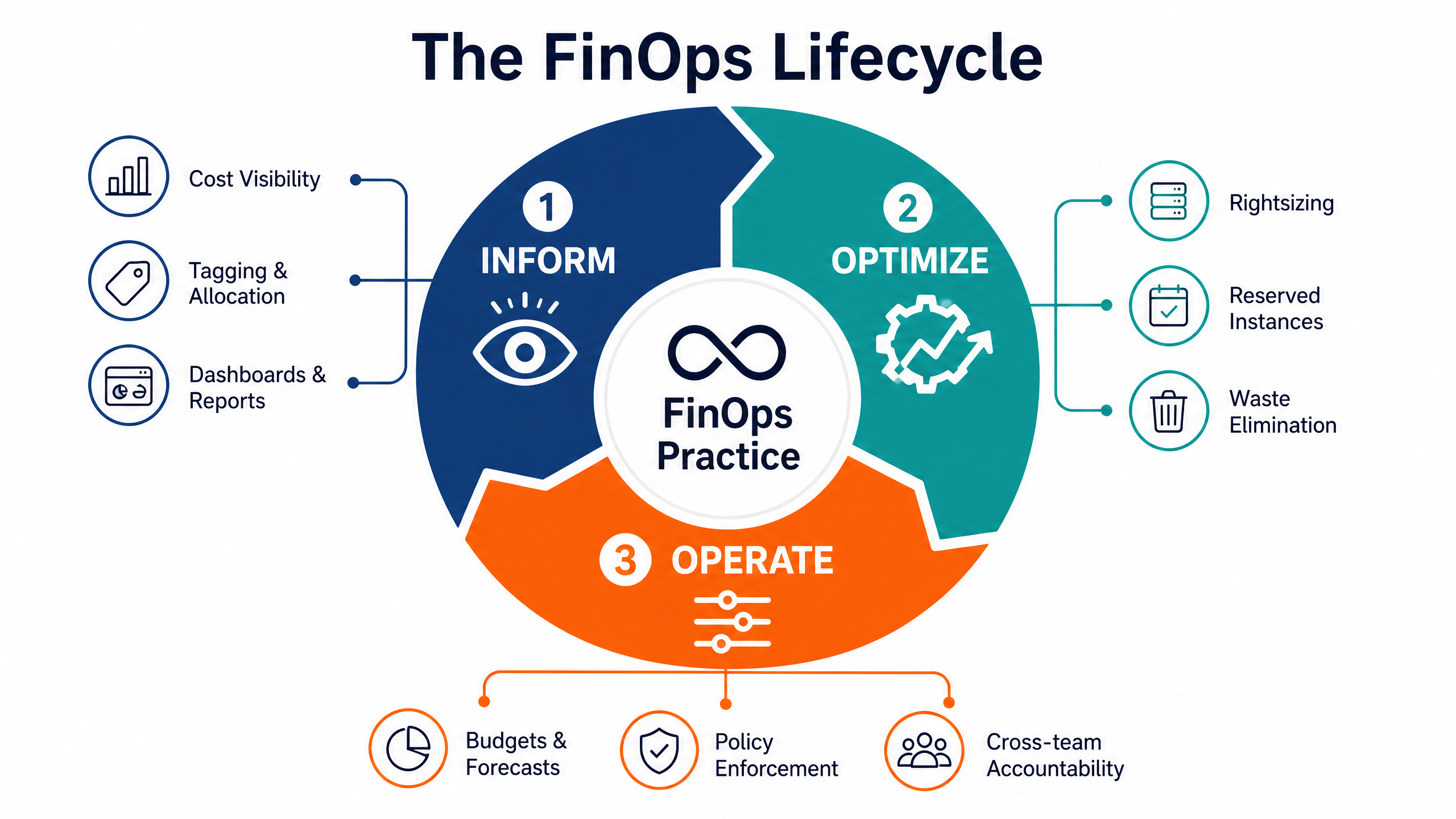
1. Inform (Visibility & Allocation)
The foundation of FinOps is visibility. Organizations cannot optimize what they cannot see. This phase involves accurate tagging, mapping cloud spend to business units, and creating dashboards. The goal is to establish accurate cost allocation and understand the true unit economics of the business.
2. Optimize (Rightsizing & Rates)
Once visibility is achieved, teams focus on optimization. This involves:
- Usage Optimization: Rightsizing instances, shutting down idle resources (waste elimination), and modernizing architecture.
- Rate Optimization: Leveraging discount instruments like Reserved Instances (RIs) and Savings Plans to lower the cost of compute.
3. Operate (Continuous Improvement & Governance)
The final phase embeds FinOps into the organizational culture. This includes setting budget guardrails, enforcing policies, implementing anomaly detection, and ensuring cross-team accountability. The objective is to proactively manage costs before they spiral out of control.
The FinOps Maturity Model: Crawl, Walk, Run
Implementing FinOps is a journey. The FinOps Foundation proposes a maturity model to help organizations assess their capabilities and scale their practices iteratively.
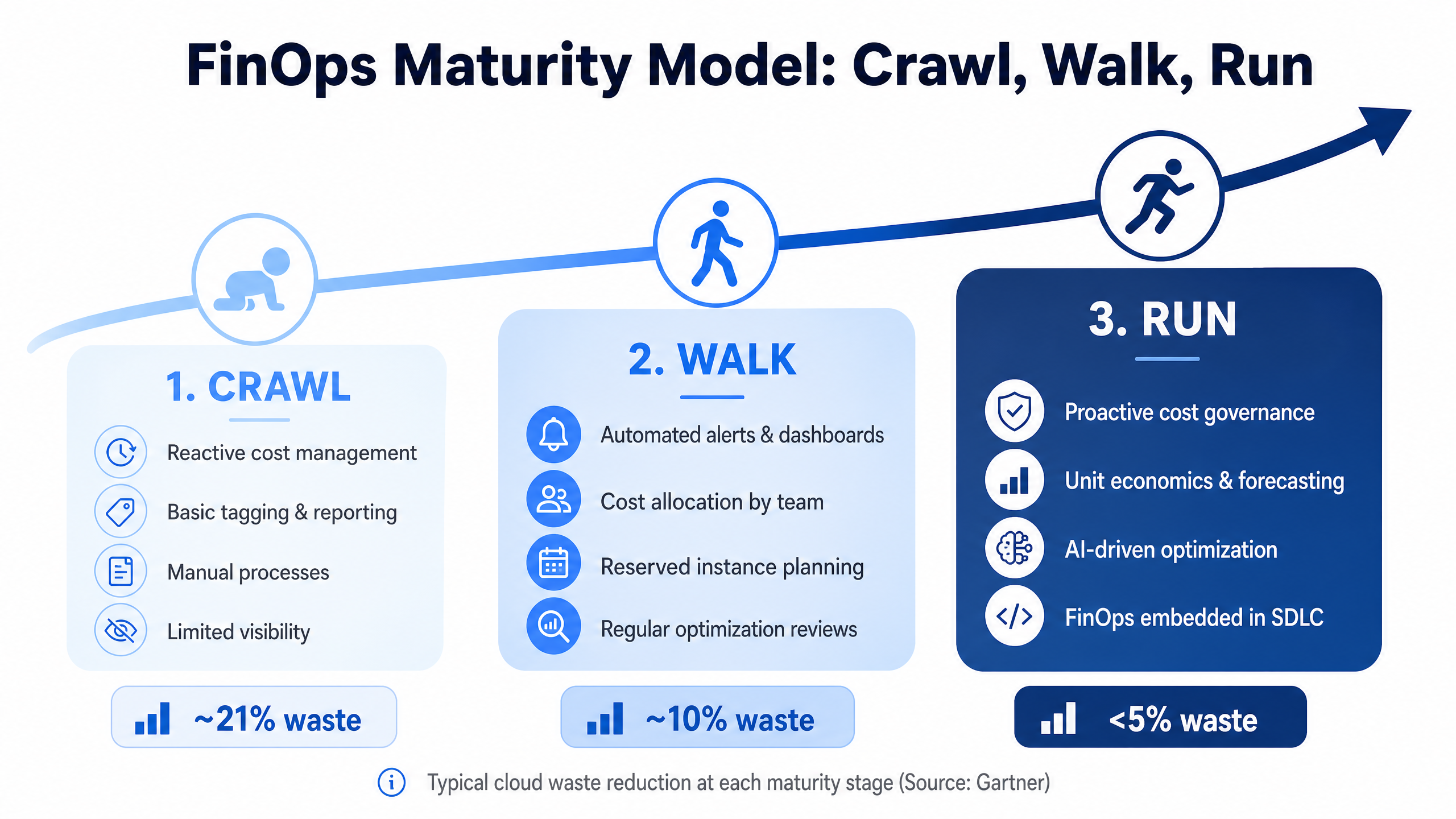
| Stage | Characteristics | Waste Reduction Impact |
| Crawl | Highly reactive. Focuses on addressing problems after they occur. Basic tagging, manual processes, and limited visibility. | ~21% waste |
| Walk | Proactive processes emerge. Automated alerts, clear cost allocation by team, regular optimization reviews, and planned reserved instance purchasing. | ~10% waste |
| Run | Fully proactive and integrated. FinOps is embedded in the Software Development Life Cycle (SDLC). Focus on unit economics, AI-driven optimization, and automated cost governance. | <5% waste |
Note: Waste reduction estimates are illustrative based on industry averages.
Why Finops Southeast Asia Needed Now
Southeast Asia is currently undergoing a massive digital transformation. Indonesia national IT spending alone reached over $40 billion in 2023 and is projected to nearly double to $89 billion by 2028 . With global hyperscalers like AWS, Google Cloud, and Microsoft Azure expanding their data center footprints in Jakarta, cloud adoption is at an all-time high.
However, enterprises in Southeast Asia face specific challenges:
- Lack of Visibility: Rapid cloud migration often occurs without proper tagging or governance frameworks in place.
- The “Shift Left” Disconnect: Developers are often involved in cost optimization too late in the process. 55% of developers admit that purchasing commitments are ultimately based on guesswork.
- AI Sprawl: As Indonesian enterprises move AI from pilot projects to core infrastructure, managing the associated GPU and API costs is becoming a critical financial risk.
To remain competitive, Indonesian enterprises must transition from reactive IT spending to proactive technology value management.
Partner with WGS for Enterprise FinOps Success
Navigating the complexities of multi-cloud environments, AI workloads, and SaaS sprawl requires specialized expertise and robust tooling.
Walden Global Services (WGS), Indonesia’s leading enterprise IT consulting and software development company, is at the forefront of the FinOps revolution in Southeast Asia. Through our strategic partnership with Mavvrik.ai—the premier financial control center for AI and hybrid infrastructure – WGS provides end-to-end FinOps solutions tailored for large enterprises.
How WGS can transform your IT spend:
- Unified Cost Visibility: We implement platforms that aggregate data across AWS, Azure, Google Cloud, on-premise servers, and AI providers into a single pane of glass.
- Automated Governance: We help you establish budget guardrails, anomaly detection, and automated chargebacks to hold teams accountable.
- AI Cost Management: Gain granular visibility into your AI workloads, tracking costs per model call and forecasting GPU requirements before deployment.
- Cultural Transformation: Our consultants work with your engineering and finance teams to embed FinOps principles directly into your SDLC, shifting cost awareness “left.”
Stop letting cloud waste and unpredictable AI costs erode your margins. Transform your IT expenses into strategic investments that drive business value.
Contact WGS today to schedule a FinOps assessment and discover how much you could be saving.
References
[1] FinOps Foundation: What is FinOps?
[2] FinOps Foundation: State of FinOps 2026 Report
[3] MarketsandMarkets: Cloud FinOps Market Report 2025-2030
[4] PR Newswire: $44.5 Billion in Infrastructure Cloud Waste Projected for 2025
[5] Flexera: 84% of organizations struggle to manage cloud spend
[6] FinOps Foundation: FinOps Principles
[7] FinOps Foundation: FinOps Maturity Model
[8] LinkedIn: Indonesia is undergoing a major digital transformation
[9] NeuronCloud: Indonesia’s AI & IoT Market in 2026