
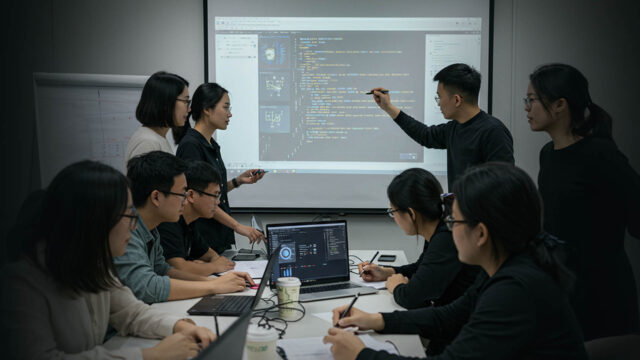
As global enterprise operations become increasingly data-centric, deploying artificial intelligence has transitioned from an experimental initiative to a core business imperative. Organizations often struggle to move machine learning prototypes into resilient production environments. Without specialized software design, robust data pipelines, and MLOps governance, enterprise AI initiatives risk model drift, integration failure, and unscalable operational costs.
Bridge the gap between experimental algorithms and enterprise-grade software with WGS AI Engineering Services. Delivered by Walden Global Services (WGS), a trusted software engineering and technical consulting firm headquartered in Bandung, West Java, WGS provides end-to-end AI engineering teams. By combining domain expertise across data engineering, full-stack interface development, model optimization, and MLOps, WGS helps enterprises build secure, scalable, and business-aligned AI systems.
Raw Multi-Source Data ➔ Automated Data Engineering ➔ Model Training & Optimization ➔ MLOps Deployment ➔ Enterprise Integration
1. The Core Engineering Bottlenecks in Enterprise AI Adoption
Attempting to implement artificial intelligence using traditional software teams or fragmented IT vendors often creates severe technical and operational hurdles:
[ Unstructured Data Silos ] ➔ [ Experimental Model Prototypes ] ➔ [ Deployment Bottlenecks ] ➔ [ Model Drift & High Latency ]
-
Fragile Data Pipelines: Inconsistent data quality, unorganized data lakes, and manual ETL processing delay model training and cause inference errors.
-
Production Deployment Barriers: Machine learning models that succeed in isolated lab environments frequently fail when integrated into low-latency enterprise microservices.
-
Model Drift & Lack of MLOps: Without automated continuous integration and continuous deployment (CI/CD) pipelines, models degrade in accuracy over time as real-world data evolves.
-
UI/UX & Accessibility Gaps: AI backend features often lack intuitive, responsive interfaces, preventing end-users from easily understanding or acting on predictive outputs.
Capability Breakdown: Specialized Roles in WGS AI Engineering Services
| AI Engineering Role | Key Technical Responsibilities | Core Tech Stack & Frameworks |
| Machine Learning Engineer | Designs end-to-end ML pipelines, optimizes model inference, and deploys algorithms to production | Python, TensorFlow, PyTorch, Scikit-learn, REST APIs, Docker, CI/CD |
| Data Engineer | Constructs scalable data lakes, builds automated ETL pipelines, and manages multi-source ingestion | SQL, Apache Spark, Airflow, Kafka, AWS, Google Cloud Platform (GCP) |
| Data Analyst | Transforms raw business datasets into executive dashboards and actionable operational insights | SQL, Power BI, Tableau, Excel, Python (Pandas) |
| AI Product Interface Engineer | Builds responsive user interfaces for smart search engines, AI chatbots, and recommendation systems | React.js, Vue.js, OpenAI APIs, Google AI APIs, RESTful Integrations |
| AI UX Designer | Designs human-centered user journeys, voice/image UI workflows, and transparent, explainable AI components | Figma, User Research, Behavioral & Ethical AI Mapping |
| AI QA Engineer | Tests automated pipelines for accuracy, monitors for bias or drift, and verifies dataset integrity | Python, Pytest, Precision/F1-Score Validation Tools, CI/CD |
| MLOps Engineer | Automates model retraining, orchestrates GPU/RAM resource scaling, and manages deployment infrastructure | Docker, Kubernetes, MLFlow, AWS SageMaker, GCP Vertex AI |
2. Strategic Pillars of the WGS Engineering Methodology
WGS avoids cookie-cutter solutions, providing a structured engineering lifecycle designed for seamless enterprise adoption:
Consultative Discovery ➔ Custom Pipeline Architecture ➔ Model Engineering & Integration ➔ Automated MLOps Governance
-
End-to-End Delivery Ecosystem: WGS manages every layer of the AI lifecycle—from data lake architecture and ingestion to frontend UX design and cloud infrastructure setup.
-
Domain-Specific Model Fine-Tuning: Algorithms and pipelines are tailored to accommodate the unique operational nuances of industries including banking, healthcare, retail, logistics, and telecommunications.
-
Responsible & Explainable AI Standards: Focuses on bias mitigation, data security compliance, and transparent decision-making outputs to satisfy corporate governance mandates.
-
Flexible Engagement Frameworks: Offers tailored consultation options—ranging from initial discovery workshops and prototype development to full co-engineering teams and managed MLOps management.
Modernizing Enterprise Stack with Walden Global Services (WGS)
Deploying enterprise-grade AI within complex corporate IT ecosystems requires experienced technical execution, agile delivery models, and strong software architecture standards.
Discovery Assessment ➔ Pipeline & UX Architecture ➔ Iterative Agile Development ➔ Managed Retraining & MLOps
The WGS Enterprise Advantage: Operating out of West Java and serving clients across Indonesia and internationally, Walden Global Services (WGS) acts as a premier tech partner for WGS AI Engineering Services. WGS bridges the gap between software development and emerging AI capabilities. By embedding specialized ML engineers, data architects, and MLOps experts directly into client workflows, WGS enables organizations to modernize their legacy software systems, automate complex business processes, and achieve measurable ROI from their technology investments.
Partnering with WGS enables technology leaders to eliminate AI deployment roadblocks, protect data infrastructure, and build scalable, future-ready business applications.