
Beyond Legacy Bottlenecks: Accelerating Digital Transformation through Enterprise Agility
As enterprise organizations scale and digitize operations, traditional “Waterfall” software development methodologies frequently become operational bottlenecks rather than competitive advantages. Rigid planning cycles, long delivery horizons, and siloed communication delay feedback loops and slow time-to-market.
Furthermore, project delays, talent attrition, and legacy system integration hurdles prevent internal IT teams from keeping pace with evolving business demands.
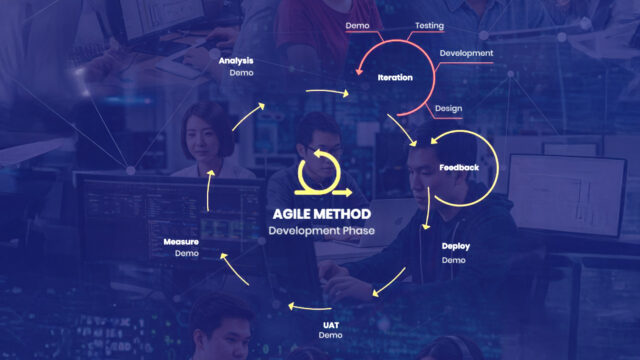
Deploying WGS Agile Software Development provides enterprise organizations with a flexible, collaborative engineering framework—combining cross-functional technical teams, strict quality engineering standards, and continuous sprint iterations to deliver scalable enterprise software.
Rigid Waterfall Specs ➔ WGS Agile Sprint Engine (Cross-Functional Pods) ➔ Rapid, High-Quality Software Delivery
1. Enterprise IT Strain Under Traditional Development Models
Managing large-scale software engineering initiatives without an adaptive methodology introduces several critical operational vulnerabilities:
[ Delayed Time-to-Market ] ➔ [ Siloed Department Misalignment ] ➔ [ Talent Attrition Risks ] ➔ [ Stalled Innovation ]
-
Delayed Time-to-Market: Multi-month release schedules prevent real-time user feedback, resulting in outdated features by the time software reaches production.
-
Siloed Team Communication: Business stakeholders and technical teams operate in isolation, causing misaligned priorities and wasted development cycles.
-
Talent Instability & Attrition: Project delays frequently stem from developer turnover, skill shortages, or ineffective resource allocation.
-
Legacy Infrastructure Friction: Integrating modern digital applications with rigid legacy architectures creates complex integration hurdles without iterative testing.
Capability Matrix: Traditional Waterfall vs. WGS Agile Software Development
| Operational Dimension | Traditional Waterfall Approach | WGS Agile Software Development |
| Delivery Cadence | Monolithic releases (months/years) | Incremental sprint releases (2-week iterations) |
| Adaptability to Change | Rigid scope changes require heavy re-budgeting | Continuous prioritization based on live market feedback |
| Quality Assurance (QA) | End-of-project testing queues | Continuous automated testing integrated into every sprint |
| Team Structure | Isolated functional departments | Dedicated, cross-functional engineering pods |
2. Core Operational Capabilities: The WGS Agile Workflow
Walden Global Services executes a structured, repeatable sprint process designed to maximize visibility and maintain software quality:
Sprint Planning ➔ Daily Stand-Ups ➔ Development & CI/CD ➔ Automated QA ➔ Sprint Demo & Retro
-
Sprint Planning & Backlog Grooming: Defines clear business objectives, prioritizes user stories, and allocates tasks for two-week development cycles.
-
Daily Stand-Up Alignment: Maintains daily team synchronization to identify blockers, adjust workflows, and ensure project momentum.
-
Continuous Engineering & Integration: Engineers build features using repository version control, continuous integration pipelines, and automated test scripts.
-
Sprint Review & Retrospective: Demonstrates working software to enterprise stakeholders and evaluates sprint performance to refine future cycles.
3. Dedicated Cross-Functional Pod Structure
Every WGS Agile Software Development team is structured as a self-contained, multidisciplinary unit aligned around your business goals:
-
Project Coordinator & Engineering Manager: Directs sprint goals, manages client communication, and oversees code architecture standards.
-
Front-End, Back-End, & Mobile Developers: Crafts responsive user interfaces, secure REST/GraphQL APIs, and cross-platform mobile applications.
-
UI/UX Designers: Delivers intuitive user interfaces aligned with corporate brand standards.
-
QA Officers & System Administrators: Executes continuous automated testing and manages cloud deployment infrastructure.
Strategic System Implementation: The WGS Agile 2-Weeks Trial
To demonstrate capability and align workflows before committing to long-term engagements, Walden Global Services offers an enterprise trial model.
Alignment Workshop ➔ Dedicated Sprint Execution ➔ Transparent QA & Reporting ➔ Final Value Evaluation
The WGS Engineering Advantage: Based in Indonesia and supporting enterprises across Asia, Walden Global Services (WGS) delivers WGS Agile Software Development backed by full-time engineering talent and a thrive-oriented developer support network. Through the Agile 2-Weeks Trial, enterprise leaders engage a dedicated pod, evaluate WGS technical delivery in real time, and align sprint workflows with internal corporate culture—mitigating long-term vendor risk.
By partnering with WGS, enterprise IT leaders eliminate delivery bottlenecks and establish a predictable, high-speed software development lifecycle.