
Here is the SEO-optimized version of your article, structured to maximize your Yoast SEO score while preserving its forward-thinking, authoritative tone.
The focus keyphrase chosen for this piece is “smart resource recovery” (with secondary variations like urban waste management and smart city infrastructure).
Transforming Urban Waste: The Shift to Smart Resource Recovery
In the past, urban waste management was simple: you threw it away, a truck picked it up, and it disappeared into a landfill. But as our cities grow, we are running out of space. Consequently, the financial and environmental costs of traditional disposal are skyrocketing.
The future of the “Green Metropolis” lies in smart resource recovery. This means shifting away from linear disposal mindsets and treating every piece of discarded material as a valuable asset that can be tracked, sorted, and sold back into the circular economy.
To achieve this, forward-thinking municipalities are replacing legacy setups with interconnected, data-driven frameworks.
The 3 Pillars of Modern Smart Resource Recovery
Building a modern circular city requires a multi-layered approach to technology. This reference framework breaks the transformation down into three highly actionable, tech-driven solutions across the municipal ecosystem:
1. The “Digital Brain” for Real-Time Monitoring
The biggest challenge for any modern city is the invisible flow of waste. A smart city solves this by creating a centralized digital platform that monitors the city’s resource lifecycle in real-time.
-
IoT Smart Bins: Instead of trucks driving on rigid, fixed routes, IoT sensors transmit real-time fill levels to a central dashboard. This eliminates empty pickups, reduces urban traffic, and slashes municipal fuel expenditures.
-
Asset Tracking: By deploying digital identifiers such as QR codes and RFID tags, city planners gain complete visibility over resource migration, allowing them to predict exactly where to deploy collection infrastructure.
2. Frictionless Citizen Engagement Networks
A sustainable city framework only succeeds if its residents participate actively. By moving away from punitive measures and focusing on a frictionless, incentive-based network, cities can drive massive compliance.
-
App-Based City Access: Citizens utilize a lightweight mobile application to locate the nearest automated collection points or to instantly check in their recyclables.
-
Digital Incentive Wallets: By linking disposal metrics to a digital wallet, residents can earn points or utility bill credits each time they recycle. This effectively turns a civic duty into a rewarding daily habit.
-
Data Transparency: When individuals can track exactly how their discarded plastic was processed and turned into new municipal park benches, public trust in green initiatives increases exponentially.
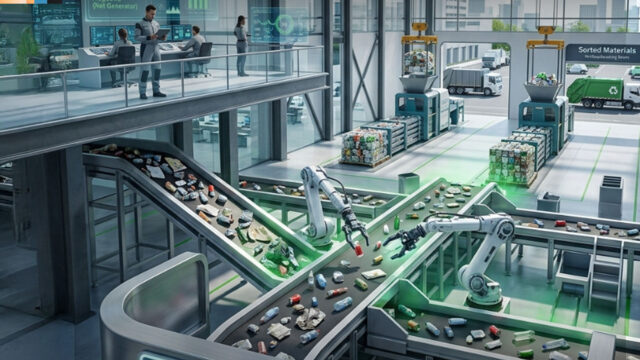
3. Automated AI Recovery Hubs
Once materials are gathered, the true transformation occurs at the processing center. Traditional manual sorting is notoriously dangerous, slow, and prone to human error.
Incoming Mixed Waste ➔ AI Computer Vision ➔ Precision Robotic Sorting ➔ High-Purity Recyclables
-
Advanced AI Vision: Utilizing high-speed industrial cameras and custom computer vision, the system identifies the distinct differences between a milk carton, a plastic bottle, and cardboard in milliseconds.
-
Precision Sorting Automation: Specialized robotic arms and optical air-jets sort these items with up to 99% accuracy. This extreme purity allows the local government to sell these materials to manufacturers at premium market rates, converting a traditional cost center into a reliable revenue stream.
Why WGS is the Ideal Digital Backbone Partner
Building a city-scale digital resource platform is a massive technical undertaking. It requires more than standalone software; it demands a fully integrated digital infrastructure. Walden Global Services (WGS) provides the specialized engineering and consultancy required to implement this entire ecosystem:
-
Integrated AI Solutions: We build and deploy the advanced computer vision models that allow municipal recovery centers to identify and sort materials autonomously.
-
Enterprise Cloud Systems: WGS designs the highly scalable, secure cloud architecture necessary to process millions of live data packets from IoT sensors distributed across an entire metropolis.
-
Custom Mobile Platforms: We develop intuitive, secure citizen-facing mobile applications that manage localized loyalty programs and handle digital token incentives safely.
-
Smart Governance Analytics: We deliver comprehensive management dashboards, giving city leaders the real-time data they need to track green KPIs and balance municipal budgets.
Turning a Cost Center into a Profit Center
Transitioning to smart resource recovery is no longer just an environmental ideal; it is an economic necessity. By deploying targeted digital infrastructure, municipalities can stop burying valuable materials and start building a self-sustaining city.
The Bottom Line: Don’t manage waste. Track it, reclaim it, and monetize it.
WGS stands ready to help your organization design, build, and scale the digital infrastructure needed for long-term urban sustainability.