
Building Software Has Never Been Simple
Building software has never been a matter of simply writing code. Every successful digital product starts with careful planning, a clear understanding of business objectives, and alignment between stakeholders and development teams.
For years, organizations have invested significant effort into defining requirements before development begins. This approach exists for a reason. Software projects involve multiple stakeholders, operational processes, technical considerations, integrations, and long-term business goals. Decisions made early in the software development process can have a substantial impact on the final outcome.
The challenge is that even with detailed planning, many assumptions remain untested until users can actually interact with the software.
A workflow that appears perfect on paper may feel cumbersome in practice. Features that seem essential during planning sessions may prove unnecessary when tested by real users. As a result, organizations often discover valuable insights only after development has already begun.
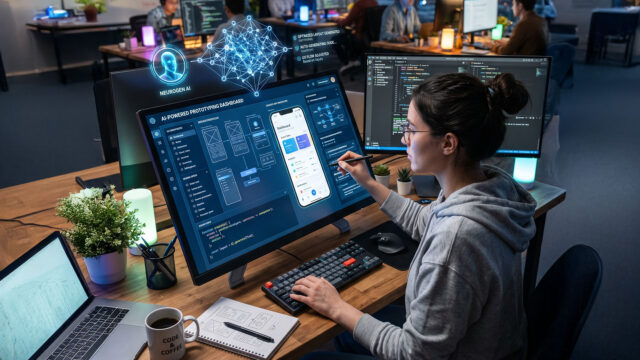
Today, Artificial Intelligence is helping businesses approach this challenge differently. AI-assisted development does not eliminate the need for planning. Instead, it creates new opportunities to validate ideas earlier through rapid prototyping. Rather than relying solely on documents, wireframes, and discussions, stakeholders can experience working prototypes sooner, provide feedback faster, and make more informed decisions before moving into full-scale development.
This shift is changing how modern organizations approach digital transformation, software development, and AI adoption.
Why Rapid Prototyping Matters More Than Ever
One of the most significant advantages of AI-assisted development is the ability to transform ideas into tangible prototypes within a much shorter timeframe.
Traditionally, stakeholders often had to evaluate concepts based on presentations, requirement documents, or static mockups. While these tools remain important, they do not always provide a complete picture of how a solution will function in a real-world environment.
Traditional Development: Document ➔ Mockup ➔ Long Dev Cycle ➔ User Testing
AI-Assisted Development: Document ➔ AI Prototype ➔ Immediate User Feedback ➔ Scaled Dev
With AI-assisted development, organizations can move from concept to working prototype much faster. This allows business users, department leaders, and executives to interact directly with the proposed solution. Ultimately, it helps them:
-
Identify immediate workflow improvements.
-
Validate business assumptions early.
-
Align stakeholder expectations before larger development efforts begin.
The result is not less planning, but better planning. Instead of making critical decisions based on assumptions, organizations can make choices based on experience and feedback.
Combining AI Innovation with Human Expertise
While AI has dramatically improved the speed at which prototypes can be created, successful software development still depends heavily on human expertise. AI can assist with generating interfaces, workflows, documentation, and technical components. However, it cannot replace:
-
Deep business understanding
-
Enterprise architectural thinking
-
IT governance and compliance
-
Advanced security considerations
-
Long-term strategic decision-making
WGS combines modern AI-assisted development methodologies with experienced consultants, solution architects, designers, and engineering teams. The goal is not simply to develop software faster, but to help organizations build the right solution from the beginning. By combining business discovery, rapid prototyping, and scalable development capabilities, we enable companies to reduce uncertainty while accelerating innovation.
The WGS Approach: Prototype, Validate, Scale
The traditional software development process often asks stakeholders to commit to an expensive solution before they have fully experienced it. WGS takes a different approach.
Our Philosophy: Validate the user experience through working models before writing the first line of production-grade code.
The journey begins with understanding the business challenge, operational requirements, and strategic objectives. Once key opportunities are identified, AI-assisted development tools are used to create an initial working model of the solution.
This prototype serves as a practical tool for stakeholder validation. Users can interact with the application, evaluate workflows, and provide meaningful feedback based on actual experience rather than assumptions.
Once the concept is validated, WGS extends the solution through its dedicated engineering teams. Supported by AI-powered development practices, these teams transform validated concepts into secure, scalable, enterprise-ready applications. This approach allows organizations to move forward with greater confidence while maintaining flexibility throughout the development lifecycle.
Enterprise AI Development Solutions Beyond Chatbots
Many organizations still associate AI primarily with chatbots or virtual assistants. In reality, AI is becoming a foundational technology across nearly every area of business operations. Companies are successfully using AI to:
-
Streamline internal workflows and eliminate bottlenecks.
-
Automate repetitive operational tasks.
-
Improve customer experiences with predictive insights.
-
Analyze large volumes of data for enhanced decision-making.
-
Create entirely new digital products and revenue streams.
The most successful AI initiatives are not driven by technology alone. They begin with a clear understanding of business objectives and are supported by a structured implementation strategy. Through its custom AI Development Solutions, WGS helps organizations identify practical use cases, build prototypes, validate business value, and implement scalable solutions that deliver measurable outcomes.
The Future of Software Development Is Collaborative
The rise of AI is not replacing software teams. Instead, it is changing how software is designed, validated, and delivered. Business leaders can now participate earlier in the development process. Stakeholders can see ideas come to life faster. Development teams can focus more on innovation and complex problem-solving rather than repetitive implementation tasks.
Most importantly, organizations can reduce uncertainty by validating concepts before committing to large-scale development efforts. This represents a fundamental shift in how digital products are built. The future is not about replacing planning with AI. It is about combining strategic planning, human expertise, and AI-assisted development to create better software outcomes.
At WGS, this combination enables organizations to move from idea to validated solution faster. We help businesses innovate with greater confidence while maintaining the quality, scalability, and governance required for long-term success.